
Article7 min read
Why real-time temperature monitoring, and when it isn't worth it
A device read on arrival and one that reports in transit record the same excursion. Real-time changes when someone finds out, and so what they can still do: cut it short, release on arrival, fix the lane. Where that pays, and where a device read on arrival is the better choice.
On this page
A pallet of refrigerated medicine waits on an airport apron while its flight is delayed, and it starts to warm. A device read on arrival and a device that reports in transit will both record that. The one that reports in transit tells someone while the pallet is still on the apron. The one read on arrival tells them after the shipment has landed and someone has read it out. Everything else follows from that difference.
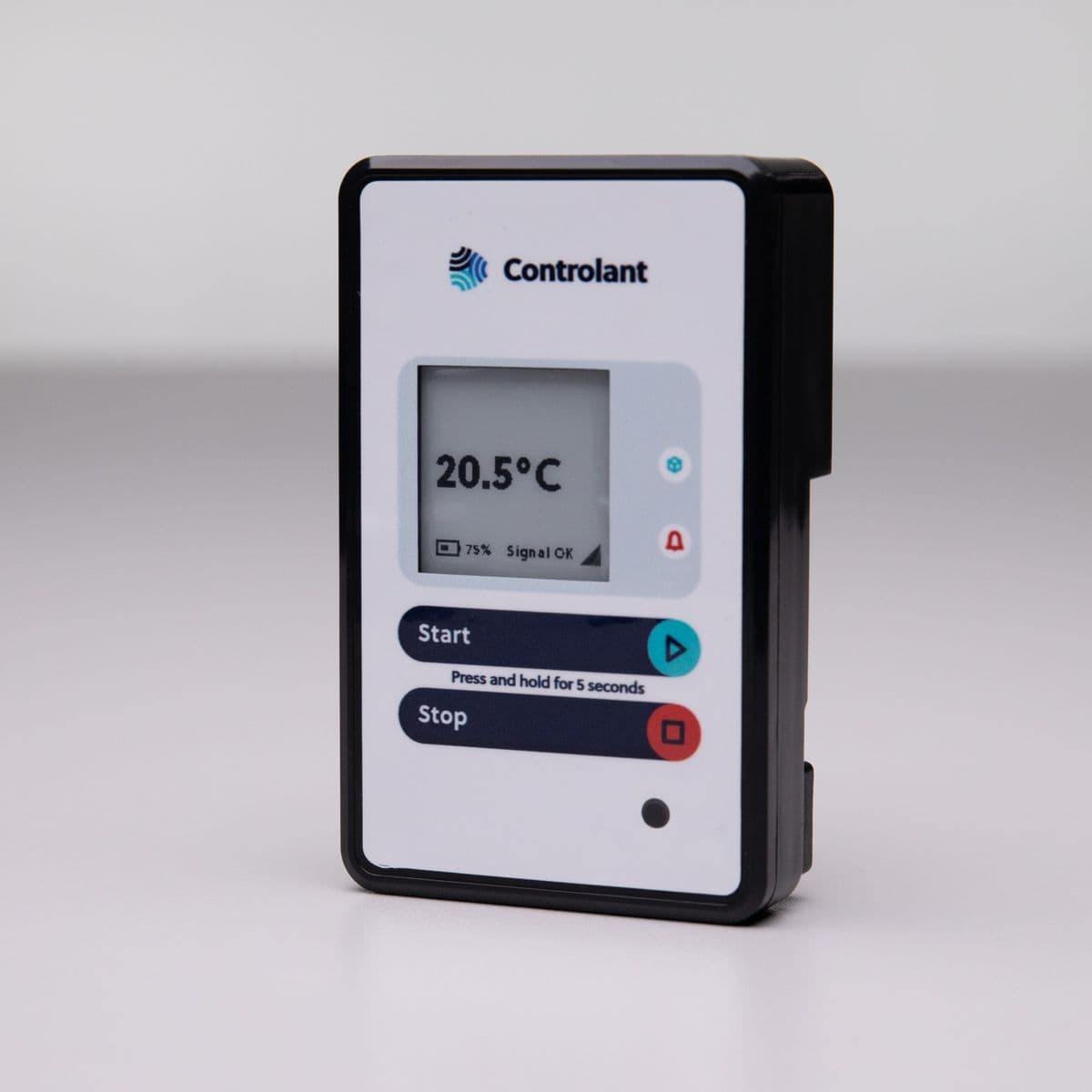
Real-time temperature monitoring means using a device that sends its readings during the trip, over the cellular network or by satellite, instead of keeping them until someone reads it out on arrival. Controlant makes real-time devices, so we have a view. This article sets out what reporting in transit changes, with examples customers have described in public, and where a device read on arrival is the better choice.
One delay, found two ways
IllustratedRead on arrival
Keeps its record until someone reads it out
Reports in transit
Sends its readings during the trip
1At the warehouse
Read on arrival
In rangeRecording.
Reports in transit
In rangeReporting.
2Delayed on the apron
Read on arrival
Too warm, unseenRecorded, but no one can see it. The pallet waits on the apron until it is loaded.
Reports in transit
Too warm, alert sentThe team watching is told at once, and the pallet is moved into cold storage.
3At the destination
Read on arrival
QuarantinedThe read-out shows the excursion. The product is held while it is assessed.
Reports in transit
ReleasedThe record is already complete, and the shorter excursion stayed within the stability budget.
The benefits: what changes when you find out in transit
An excursion can still be cut short
A device read on arrival tells the receiving site what happened after it is over. A device that reports in transit raises the alarm while the excursion is still happening, when a pallet can still be moved off an apron, a container's power restored, or a delayed shipment put on another flight. The World Health Organization (WHO) already asks for arriving shipments to be moved off the airport apron or the wharf into temperature-controlled storage as soon as possible; a device that reports from the apron tells someone when that has not happened.
The Medicines and Healthcare products Regulatory Agency (MHRA), the UK regulator, puts the case in risk terms: making an excursion more likely to be detected gives earlier warning, may help prevent it, and gives greater assurance that conditions were maintained. Why the apron, customs, and handovers are where excursions cluster is in our guide to temperature excursions.
Distica, which distributes medicines in Iceland, has put it more simply:
“…when we are using the loggers in transportation, if there is a temperature deviation, we can contact the driver and take action.”
The record is complete when the shipment lands
Product that arrives does not go into saleable stock until its transport record has been reviewed and the product released. With a device read on arrival, that review waits until someone has found the device, read it out, and filed the result. If the read-out shows an excursion, the product stays in quarantine until it has been assessed.
When the record is already in the system as the shipment lands, the review can start at once, and where the rules allow it, it can be automatic: a product that stayed within its stability budget, including through an excursion the budget absorbs, needs no one to decide. At Roche, that approach has automated up to 99.5% of product releases with no human intervention, according to a joint presentation at LogiPharma Europe in 2023. How it works is on our page on Zero-Touch Release, and what any automated release needs in place, whoever provides it, is in our guide to product release after transport.
You know where the shipment is
A device that reports its location answers the other question a delay raises. World Courier has told the story of a medicine shipped from Europe to a single patient in São Paulo, which an airline flagged at a transit airport because of a mismatch in the cargo records. The shipment's device showed exactly where it was, World Courier gave that to the airline, and the discrepancy was resolved within 20 minutes. The shipment continued to São Paulo with minimal delay, and the patient's treatment stayed on schedule.
A record with a location also says where an excursion happened: which airport, which handover, which leg. That is what an investigation needs first, and it is what turns a single excursion into a fix for the next shipment on the same lane. The case for keeping a lane's risk current from every shipment that runs on it is in Why lane risk assessment is the cleanest first use case for AI in pharma.
Many shipments, one decision
When something goes wrong across a network rather than on one shipment, real-time data tells you which shipments are exposed while there is still time to act. In a webinar with Controlant in May 2026, MSD's Ruud van der Geer recalled a Saturday morning in early 2024, when several dozen MSD shipments were in transit through corridors affected by the outbreak of conflict in the Middle East. The team had less than 30 minutes to assess their exposure and decide which needed immediate intervention. Every shipment was rerouted, rebooked, or held in safe intermediate storage.
The platform gave the team the picture. Deciding which shipments mattered most was still a judgment made by people:
“Everybody comes in with a different role, a different head on, to bring their feedback on that particular shipment. A quality person, a finance person, an operational person, somebody from security. Everybody has their own ideas about why a shipment is important.”
The limits of real-time monitoring
Reporting in transit is not a guarantee. Five limits are worth knowing before you choose it.
- It prevents nothing on its own
- an alert helps only if someone sees it, at any hour, and is allowed to act on it. As the webinar with MSD put it, without clear ownership of those decisions, real-time alerts become noise rather than signal.
- Alerts have to be set well
- the MHRA has described a case where poor alarm settings meant no alarm was triggered, which gave false assurance that stock had stayed within its range. More alerts are not better ones.
- Real-time has gaps
- in the air, many devices switch their transmitter off to meet aviation rules, and on some ocean and remote legs there is no network. A device keeps recording and sends its readings when it reconnects, so what reaches the team is close to real time, not continuous, and on some legs nothing can be done until the next handover anyway.
- It sees no more of the load
- a real-time device takes a reading at intervals from one place in the load, like any other device. What changes is when the reading arrives, not how much of the shipment it measures.
- It is not required
- no regulation requires real-time monitoring. The EU Good Distribution Practice (GDP) guidelines and WHO guidance require that conditions in transit are monitored, recorded, and can be demonstrated, and leave the technology to the shipper.
What the rules do require in transit is in our guide to good distribution practice.
When a device read on arrival is the better choice
A device read on arrival records the same history for less, and for some lanes nothing more is needed:
- A robust product on a short, well-understood lane, where an excursion in transit would change nothing and the record only has to exist for the file.
- A product whose value is small next to the cost of acting on an alarm.
- A lane where no one could intervene in time even if they knew, and where release does not wait on the record.
The question is not whether real-time is better in general, but whether, on a given lane, knowing sooner would change what happens to the product or how fast it is released.
Questions to ask before choosing real-time
Who watches, and when?
Alerts arrive at night and at weekends. Decide whether your own team covers those hours or someone does it for you, and what happens when no one answers.
What are they allowed to do?
A forwarder can move a pallet; only the quality function can decide what happens to the product. Write down who may act on which alarm, and how.
How are alarms set?
Set limits and delays from the product's stability data and the lane, so that an alert means something. Review them as the lane's history builds.
Can the record support release?
If release is to start on arrival, the system that holds the record has to be validated for that use, with an audit trail.
Will the device fly, and come back?
Battery-powered devices need the airline's approval, and reusable devices need a way home.
The rules for devices in air cargo are in our guide to pharmaceutical transport.
Where Controlant fits
Controlant's Saga devices report over the cellular network while the shipment moves, and our MARS team watches shipments 24/7/365 against the limits a customer's quality team sets. When an excursion alarm fires, MARS reaches out to the forwarder and escalates to the customer's contact, by the customer's work instructions. The record is on Controlant's GxP-validated platform when the shipment lands, so Zero-Touch Release can release product within its stability budget without waiting for anyone. The devices come back and are reused.
How this compares with the other approaches is on our page comparing cold chain monitoring approaches, and what each kind of device records is in our guide to cold chain monitoring devices.
Sources
- 1A practical example of applying quality risk management in GDP: transportation risks (15 July 2020)MHRA Inspectorate blog
- 2How real-time location monitoring ensured timely medication deliveryWorld Courier
- 3Distica tells its story of working with Controlant's visibility platform (2021)Controlant
- 4From visibility to control: lessons from the front line of pharma supply chain resilience (2026), with MSDControlant
- 5Product Stability Automation, Roche with Controlant, LogiPharma Europe 2023Controlant
- 6Guidelines on Good Distribution Practice of medicinal products for human use (2013/C 343/01), chapter 9European Commission
- 7Model guidance for the storage and transport of time- and temperature-sensitive pharmaceutical products, TRS 961, Annex 9 (2011)World Health Organization
Questions people ask
What is real-time temperature monitoring?
Real-time temperature monitoring uses a device that sends its readings during the trip, over the cellular network or by satellite, so that an excursion can be seen and acted on while the shipment is still moving, rather than found when the device is read out on arrival.
Does real-time monitoring prevent temperature excursions?
Not by itself. It gives earlier warning, which can be used to cut an excursion short or stop it, but only if someone sees the alert and is allowed to act on it.
Is real-time temperature monitoring required by GDP?
No. EU GDP and WHO guidance require that temperature in transit is monitored, recorded, and can be demonstrated. They do not prescribe real-time transmission.
How does real-time monitoring speed up product release?
The record is already in the system when the shipment lands, so the review does not wait for a device to be found and read out. Where the product stayed within its stability budget, release can be automatic.
When is a device read on arrival enough?
For a robust product on a short, well-understood lane, where an excursion in transit would change nothing, no one could intervene in time, and release does not wait on the record.
More articles
All insights
Six first moves for AI in the pharma cold chain
With AI already seeping into your pharma cold chain operations, how confident are you that the plumbing underneath can take the pressure? Here are six practical first moves, distilled from our recent industry whitepaper on real-time monitoring and AI.
Read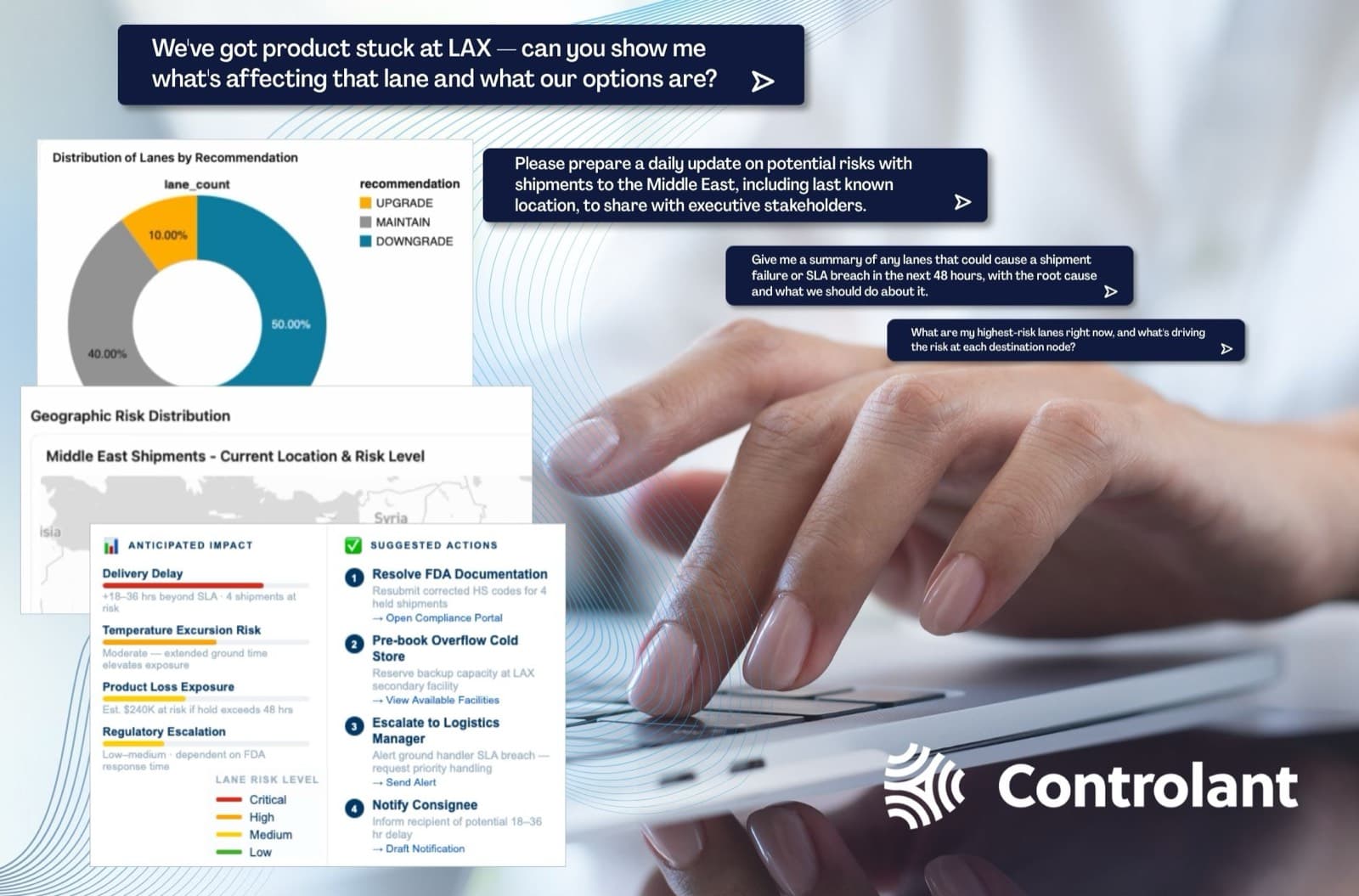
From dashboards to dialogue: why AI is replacing the supply chain control tower
For years, the answer to better cold chain management was ‘more dashboards.’ That era is ending, and what is replacing it looks very different.
Read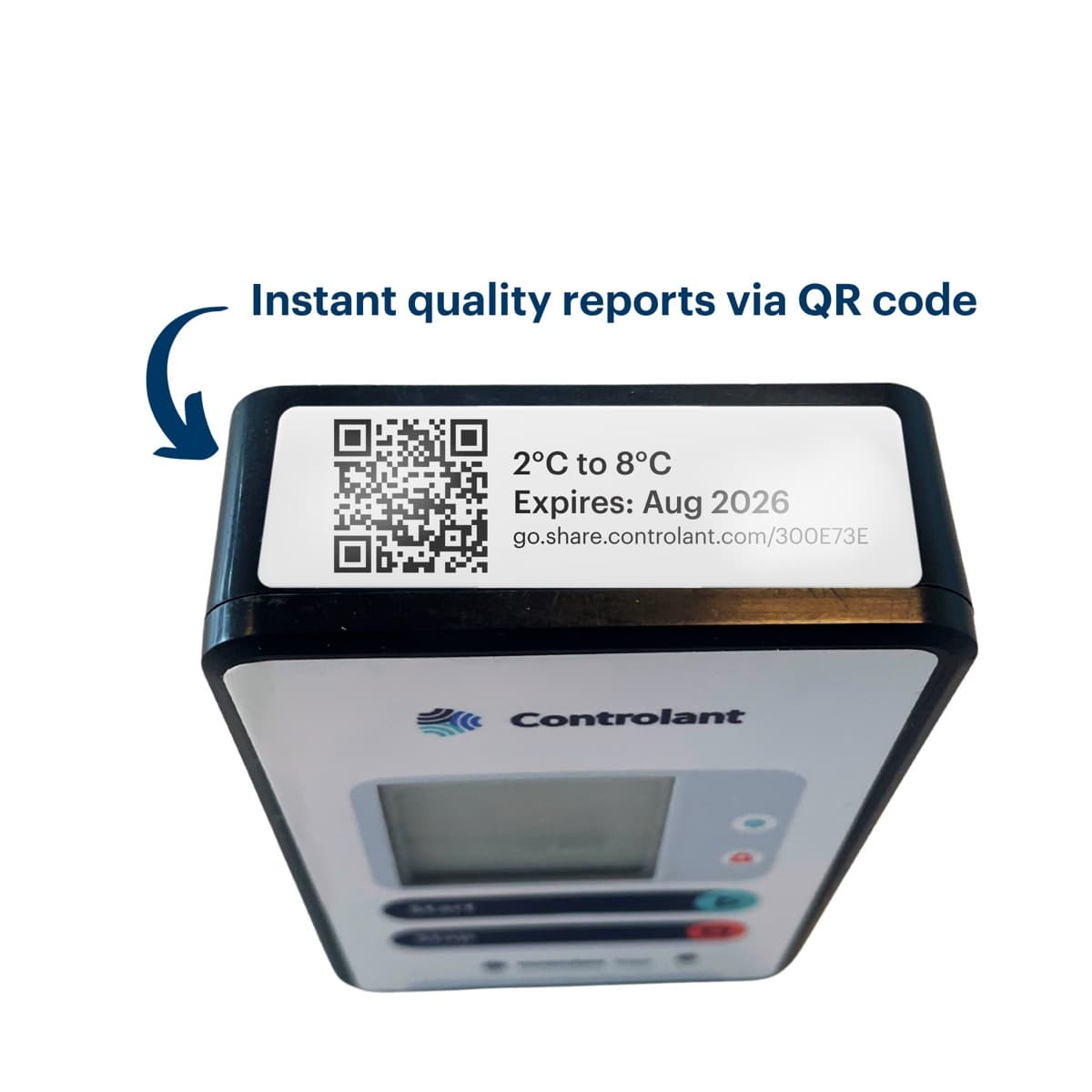
Introducing a new way to simplify real-time shipment monitoring: Controlant Go
In the fast-paced world of logistics, immediate visibility into your shipments can mean the difference between product integrity and costly losses. Controlant Go is a new streamlined solution for logistics teams who need simplicity and speed, without sacrificing compliance or quality.
ReadSee what this looks like in the platform
Tell us what you ship and where, and we'll show you the platform on routes and products like yours.