From visibility to control: Lessons from the front line of pharma supply chain resilience
In a webinar hosted 6 May, Gisli Herjolfsson, CEO of Controlant, and Ruud van der Geer, Director Global Delivery Strategy at MSD, discussed what it takes to build a supply chain that doesn't just survive disruption, but responds to it in real time. This article captures the key themes from that discussion, and shares the recording below.
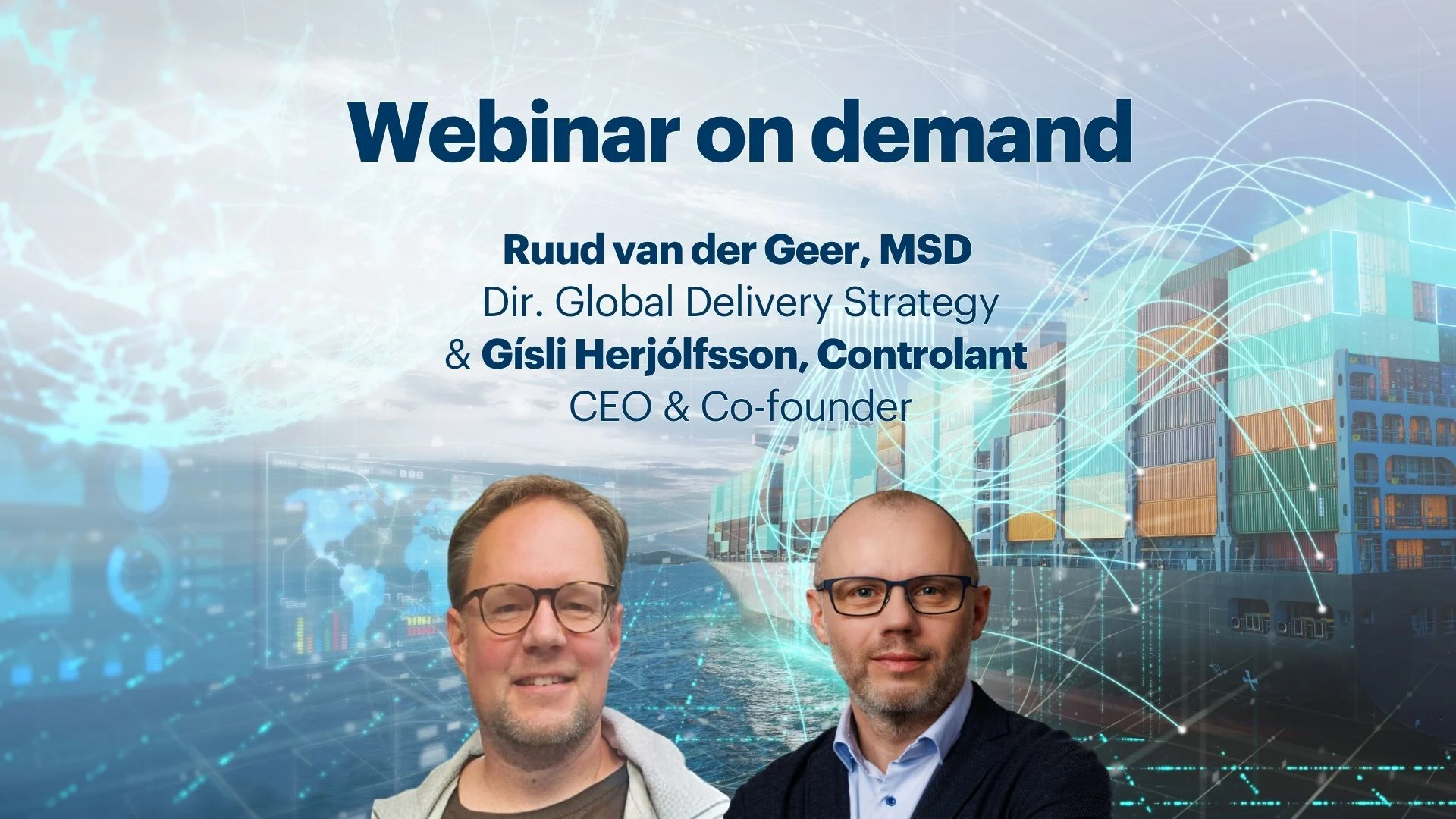
Watch the webinar
Fill in this short form to access the recording.
Most pharmaceutical supply chain teams can now tell you what happened to a shipment, but fewer can act on what's happening right now. And fewer still have built the internal processes, decision rights, and partner agreements needed to turn that visibility into control.
How do we go from passive tracking to real-time monitoring, and what changes once the technology is in place?
The gap between data and decisions
A system that shows you what happened is very different from one that helps you decide what to do next. Once your teams have real-time visibility, their focus turns to continuous monitoring and how to act on everything they see.
While that shift is progress, it also creates its own pressures. More data means more decisions. And without clear ownership of those decisions, real-time alerts become noise rather than signal.
A real crisis, handled in real time
To illustrate this, consider what happened on a Saturday morning in early 2024, when several dozen MSD shipments were in transit across corridors affected by the outbreak of conflict in the Middle East. The team had less than 30 minutes to assess exposure and determine which shipments needed immediate intervention.
The platform provided the visibility. What it couldn't automatically provide was the judgment call on which shipments were most critical, given that ‘critical’ means different things to different people.
“Everybody comes in with a different role, a different head on, to bring their feedback on that particular shipment. A quality person, a finance person, an operational person, somebody from security. Everybody has their own ideas about why a shipment is important.”
— Ruud van der Geer, Director Global Delivery Strategy at MSD
That cross-functional weighing, as van der Geer explains, is still a human exercise. And it will remain so, until teams can agree on a shared decision framework that a system can encode.
The outcome: all shipments were successfully rerouted, rebooked, or held in safe intermediate storage. But the episode surfaced a structural gap that many pharma companies are only now starting to address.
What AI needs to be truly useful
It’s easy to see how an AI-enabled supply chain could solve this challenge. But AI could just as easily amount to little more than an expensive dashboard.
“AI in supply chain operations is only as useful as the data quality underneath it."
— Gisli Herjolfsson, CEO of Controlant
The right data, with the right quality, at the right time. Without a solid data foundation, instead of value-adding AI, you have a tool that surfaces unreliable conclusions quickly.
In pharma, the data quality problem carries additional weight. GxP-regulated environments require that any system involved in product release or disposition decisions operates within a validated state; predictable, auditable, and compliant. If AI draws on unvalidated or poorly governed data, it doesn't just risk surfacing wrong answers; it risks producing outputs that cannot legally inform the decisions that matter most.
The path forward isn’t to lower the validation bar, but to ensure AI operates within validated systems, and that accountability stays with qualified humans.
Decision support, not decision replacement
Everything Controlant builds is designed around GxP-validated, pharma-grade data as a baseline. With data quality already at the level AI demands, a demonstration of Controlant’s early-stage intelligence layer shows daily risk profiles being delivered across active shipments, surfacing the items that need attention without requiring a logistics expert to manually triage every data point.
The most valuable near-term applications are not autonomous decision-makers. They are tools that compress the time between ‘I need to understand the situation’ and ‘I’m ready to act’.
For decisions that follow a clear, agreed logic, automation makes sense; routine rerouting, temperature threshold alerts, compliance checks, for instance. For decisions that involve competing priorities across departments, the human element remains essential. And in a highly regulated industry, accountability cannot sit with a system.
Resilience is built before the crisis arrives
Responding well to disruption has less to do with the technology available on the day than with the groundwork laid before it.
The extent to which teams successfully navigate a pandemic, a conflict, or airport congestion during peak periods, depends on the extent to which they have already invested in data quality, partner relationships, clear decision rights, and the habit of using the platform in stable times.
"Resilience isn't necessarily a technology story. It's a process story, with technology as an enabler."
— Gisli Herjolfsson, CEO of Controlant
The process, the people, and the agreements around it are what make it work.
Watch the webinar
Fill in this short form to access the recording.
Related whitepaper
From real-time data to real intelligence, examines how AI is reshaping pharmaceutical cold chain management, drawing on an on-stage conversation at LogiPharma EU 2026 with GSK’s Saddam Huq.