From dashboards to dialogue: why AI is replacing the supply chain control tower
For years, the answer to better cold chain management was ‘more dashboards.’ That era is ending, and what is replacing it looks very different.
Walk into almost any pharma supply chain operations center and the visual language is instantly familiar: a wall of dashboards, color-coded maps, line charts, heat grids, and an alert ticker down the side. For the better part of a decade, this has been the image of a digitally mature cold chain. Build more sensors, pipe the data into the cloud, surface it on a screen, and the supply chain runs itself.
Except, of course, it doesn’t. Dashboards don’t run supply chains, people do. And there are far more dashboards than there are people.
The data paradox
The move from passive loggers to real-time IoT monitoring has been one of the most important shifts in pharma logistics this century. Controlant, a pioneer of that shift, first convinced a pharma company to adopt real-time across its full network in 2018. Five more customers, all global pharma companies, followed within two years of COVID. Today, leading operators are running at over 99.99% data availability on real-time-enabled lanes. Operational results include massive reductions in product waste from temperature excursions, and, where temperature-based auto-release has been adopted, shorter lead times.
Real-time visibility didn't just add data, it made data constant. But those gains created a new challenge. More data meant more dashboards, making it harder for any individual operator to know what to look at.
“I’ve seen more dashboards than I can count. The most common problem isn’t the lack of data, but the lack of an efficient way to cut through the noise.”
Gísli Herjólfsson, CEO, Controlant, speaking at LogiPharma EU 2026
Data visualization was the right answer to the problem of 2015. It is not the right answer to the problem of 2026.
The question-and-answer supply chain
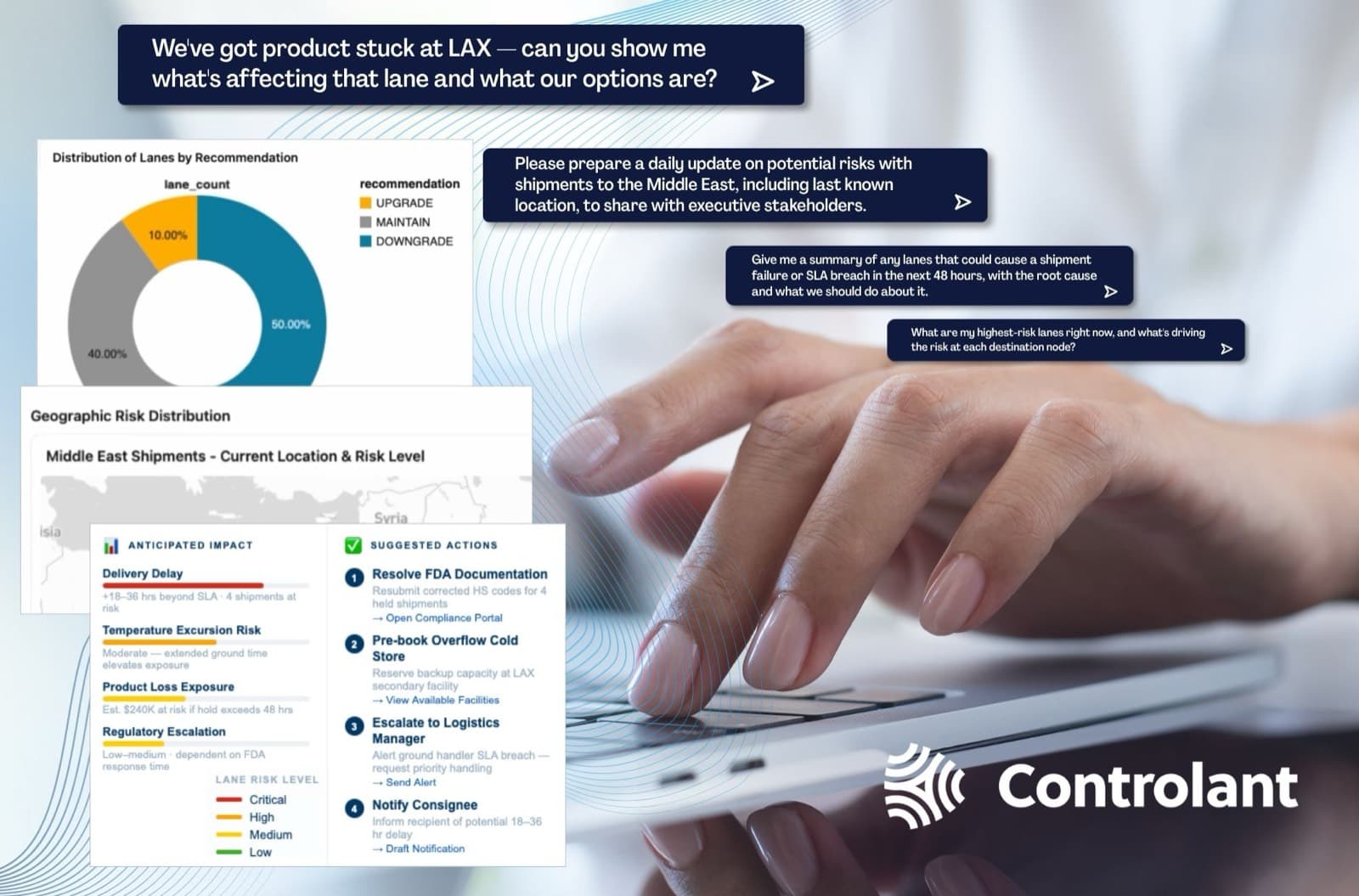
The point was never the dashboard. It was being able to ask a question and get an answer. Supply chain teams are starting to skip the dashboard and go straight to the question, the way they already do with colleagues: by asking.
Natural-language interfaces backed by validated, curated cold chain data let an operator ask “which lanes have seen the most temperature excursions this quarter, and which carriers are driving them?” and get a structured answer in under a minute. That is the same answer a three-person analytics team might have produced in three days. For the analyst, it looks like a threat; for the supply chain manager, it looks like leverage.
What changes for supply chain leaders
The end of the dashboard era is not the end of data. It is the end of data as the output. In the new phase of pharma cold chain, data is the input, and insight, recommendation, and action are the output.
Practical implications for supply chain leaders are that analysts will spend less time building reports and more time validating recommendations, operators will stop scrolling through shipment lists and start triaging prioritized risk briefs, and leadership will ask sharper questions, more often, because the cost of asking them has collapsed.
None of that is a reason to rip out the dashboards or topple the control towers. A traditional control tower watches the data. An AI control tower acts on it. For this to work, three things have to be true:
- The data has to be qualified end to end, as AI output is only ever as good as the data it’s built on.
- The cold chain has to be described to the model with enough semantic context that it can reason, not just pattern-match.
- The organization has to treat AI output as decision support, not decision authority, so that quality and validation teams can sign off with confidence.
Get those right, and the dashboard becomes optional. Get them wrong, and it becomes irrelevant.
This article draws on the Controlant whitepaper “From real-time data to real intelligence: how AI is reshaping the pharmaceutical cold chain”, which builds on a conversation between Gísli Herjólfsson, CEO at Controlant, and Saddam Huq, Director of Cold Chain and Logistics at GSK, at LogiPharma EU on 15 April 2026.
See what this looks like in the platform
Tell us what you ship and where, and we'll show you the platform on routes and products like yours.