
Saga Arctic
Saga Arctic: Calibrated where frozen medicines actually travel
Built for the −30 to −20 °C band, with calibration points at −30, +5 and +30 °C, real-time reporting down to −30 °C, and the same housing, connectivity and airline approvals as every Saga.
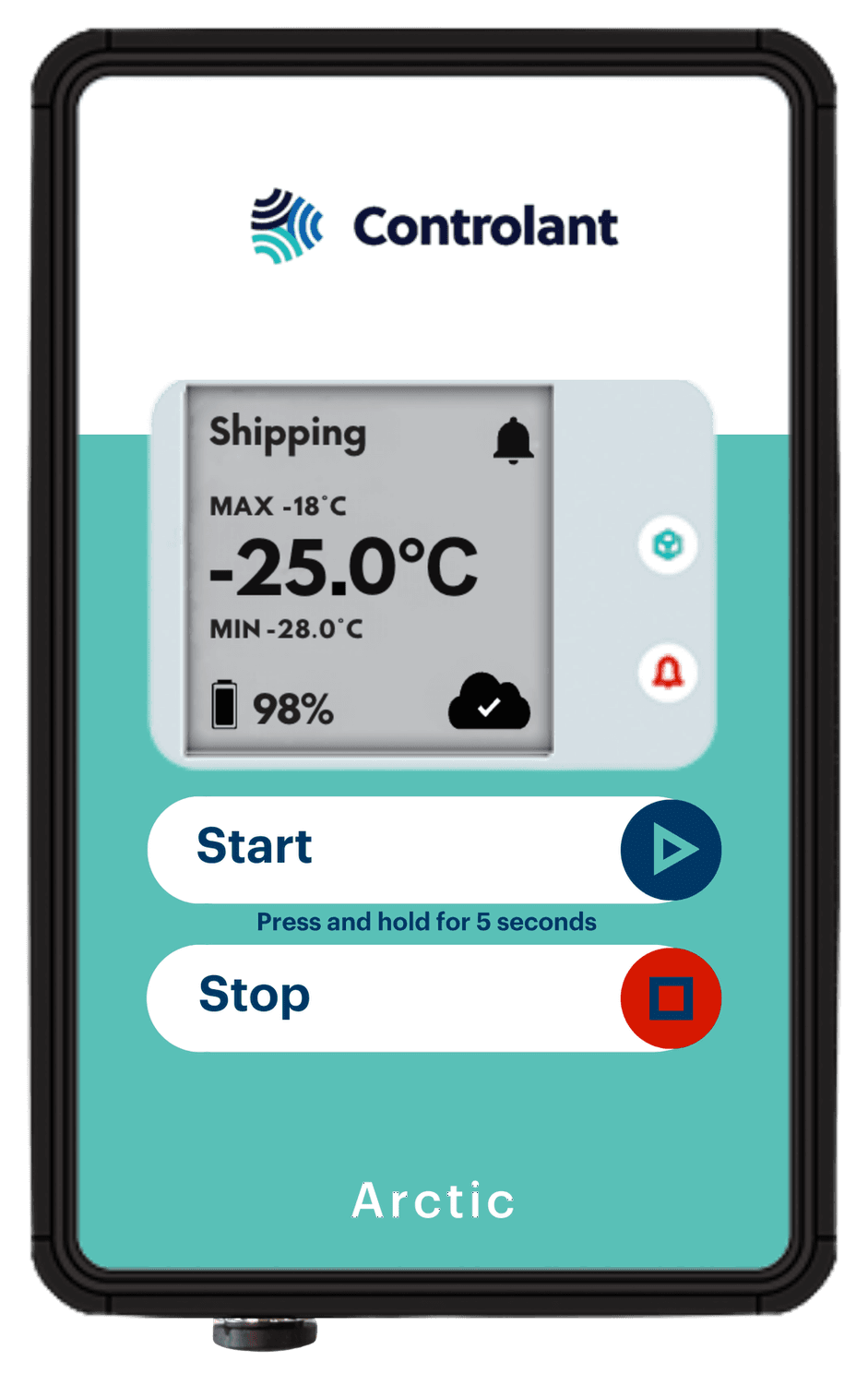
- Operating range
- −30 to +30 °C
- Accuracy
- ±1 °C
- at −30 to −10 °C
- Housing
- 61 × 103 mm
- 25 mm deep, 194 g
- IP rating
- IP55
Key capabilities
Deep-freeze calibrated
−30 to +30 °C, calibrated at −30, +5 and +30 °C against a NIST-traceable standard.
Keeps reporting through frozen temperatures
Where the Saga-P Standard stops reporting below −20 °C, Saga Arctic reports in real time down to −30 °C and keeps logging down to −35 °C.
Flight-ready
Approved by 200+ airlines, IATA, FAA and EASA compliant, automatic flight mode.
Specifications
Built for frozen lanes down to −30 °C
Full specifications from the Saga Arctic datasheet, version 1, 20 March 2026.
Limited range
Between −35 and −30 °C the device still logs. Battery life is reduced, the display is not functional, and below −30 °C it stops reporting in real time.
| Model | Saga Arctic |
|---|---|
| Standard operating range | −30 to +30 °C |
| Probe | None |
| Calibration points | −30, +5, +30 °C, NIST traceable |
| Accuracy | ±1 °C at −30 to −10 °C · ±0.5 °C at −10 to +10 °C · ±1 °C at +10 to +30 °C |
| Resolution · long-term drift | 0.1 °C · under 0.1 °C per year |
| Logging · reporting | Logs every 10 minutes · reports in real time every 1 to 24 hours, and on any excursion |
| Battery | 1200 mAh rechargeable NiMH, not dangerous goods, at least 70 charge cycles |
| Memory | 150 days of readings at 10-minute intervals |
| Connectivity · location | 4G, 3G and 2G, global · cellular triangulation and 2.4 GHz Wi-Fi detection |
| Dimensions · weight | 25 × 61 × 103 mm · 194 g |
| Housing · ingress protection | ABS · IP55 |
| Approvals | CE, FCC, IC, NOM, KC · IATA, FAA and EASA flight compliance |
Battery life
Set the wake-up interval, read the days
A fully charged device on the interval shown reports in real time and raises alarms for at least this long while monitoring a shipment inside its operating range. Below 5% charge it hibernates: it keeps logging to memory and stops reporting until recharged.
| Wake-up interval | 1200 mAh |
|---|---|
| 1 hour | 10 days |
| 2 hours | 17 days |
| 3 hours | 22 days |
| 6 hours | 37 days |
| 12 hours | 55 days |
| 24 hours | over 55 days |
Built for the deep freeze
High-value frozen medicines need monitoring that works reliably at −30 °C. Saga Arctic brings real-time visibility to the deep-freeze range without sacrificing connectivity or compliance, on short to medium-haul lanes.
Battery life on a frozen lane
Saga Arctic carries a 1200 mAh battery: up to 55 days at a 12-hour wake-up interval, which fits the shorter shipments frozen lanes typically run. An excursion wakes the device regardless of the schedule, and below −30 °C, where it stops reporting, it keeps logging to internal memory.
Device management is handled
Return logistics, calibration, and servicing are ours to run. You get maximum reuse and a circular model without adding a device operation to your own team.
Questions about Saga Arctic
What range does Saga Arctic cover?
−30 to +30 °C, calibrated at −30, +5 and +30 °C. It is accurate to ±1 °C from −30 to −10 °C, where it does most of its work, ±0.5 °C from −10 to +10 °C, and ±1 °C above that. It reports in real time down to −30 °C. Between −35 and −30 °C it still logs, with reduced battery life and no display, but stops reporting.
Why does Saga Arctic run for fewer days than the Saga-P Standard?
It carries a 1200 mAh battery rather than the 2500 mAh battery in the rest of the family: 10 days at a 1-hour wake interval and over 55 days at 24 hours.
Does Saga Arctic use a probe?
No. Saga Arctic sits with the product inside the shipment and measures the temperature right where the product is, down to −30 °C.
Related
Questions about Saga devices?
Tell us what you ship and where, and someone from our team will get back to you.