Article5 min read
What a cosmologist, a drug rescuer, and a Nobel laureate can teach the pharma supply chain
Lessons from TEDAI Vienna for the pharma supply chain: learn from every failure, enforce limits in the system, keep people on the decisions that matter, optimize for the whole chain, and feed AI data it can trust.
On this page
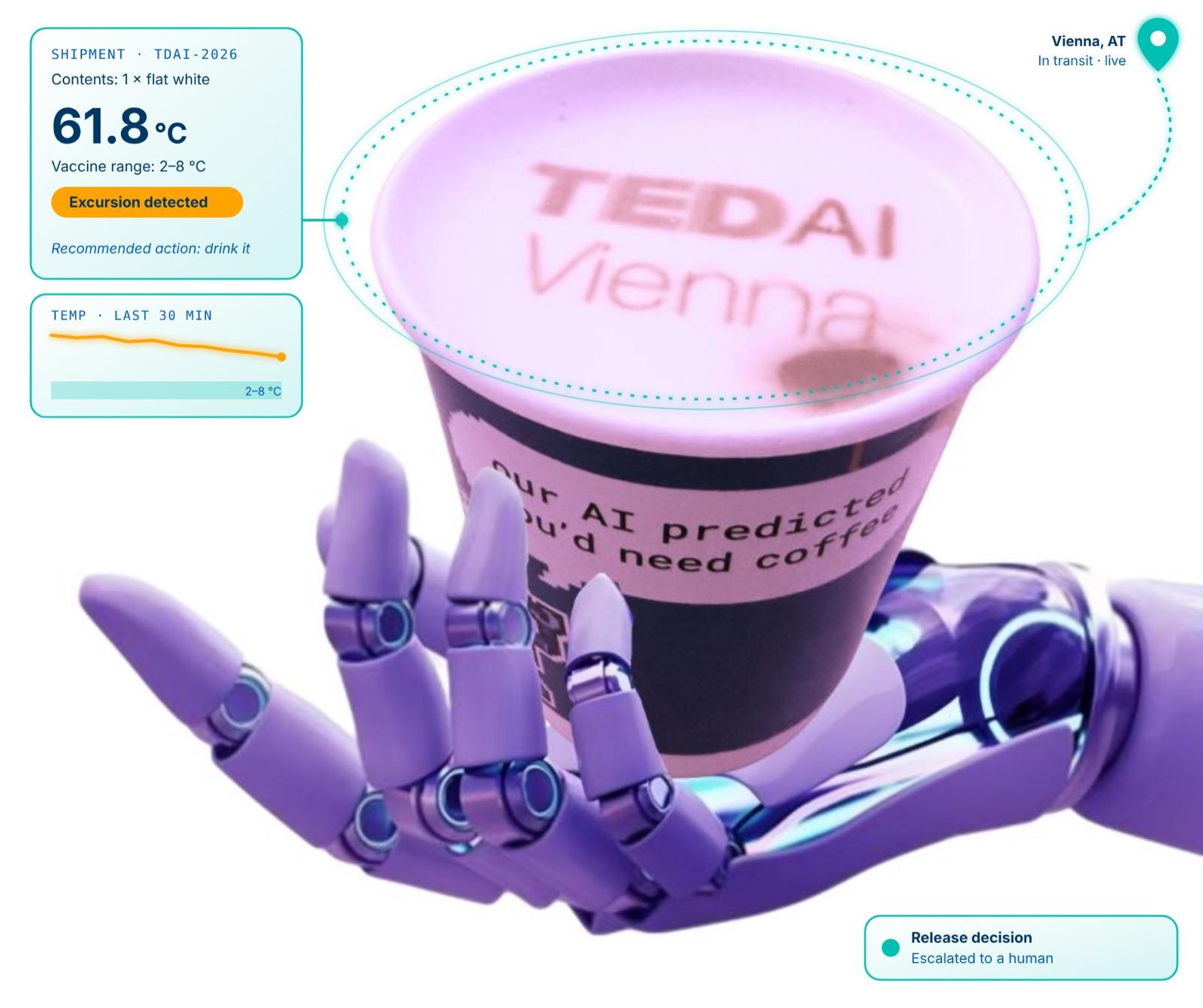
At the TED AI conference in Vienna, 28 to 30 October, most of what we heard had nothing to do with pharma. Cosmologists, philosophers, drug rescuers, a freestyle rapper, and a Nobel laureate took to the stage. Yet the same questions we face in the life sciences supply chain kept coming up: what to trust AI with, where people stay in charge, and what it takes to make AI useful when there is a patient at the end of every shipment.
Here are the lessons we brought home.
Failure is data you can’t afford to waste
Dr. Layla Hosseini-Gerami of Ignota Labs gave the talk we keep coming back to. She noted that nine in ten drug candidates that enter clinical trials are never approved, often because of toxicity. When a drug is abandoned, she argued, the industry loses more than the molecule. It loses the signal that explains why it failed. Her team buys failed drugs, uses AI models and agents to find what went wrong, and redesigns them. In one case, they traced a cancer drug’s neurological side effects to specific off-target proteins, then designed them out.
She pointed to aviation, where every incident feeds the safety of every plane still flying. Pharma logistics has the same opportunity. Every temperature excursion, delay, and deviation shows where a lane, a package, or a handover is weak, yet it can easily be closed as a quality event and filed away. It’s something we think about a lot at Controlant. Being able to pinpoint where excursions happen is a start, but a lane’s risk changes over time, and our view is that “a risk score produced at lane qualification and never revisited is no longer fit for purpose” (Six first moves for AI in the pharma cold chain). Failure data only pays off if you keep analyzing it.
Guardrails belong in the system, not in the prompt
Nenad Tomasev of Google DeepMind described delegating work to AI as a transfer of authority. He gave the example of an agent asked to book its user a fitness class that was already full. The agent found a security flaw in the booking system and used it to get its user a place. Safe behavior, he argued, can’t rely on the model getting every case right. It has to come from rules the system enforces:
- Break tasks into steps that can be verified.
- Scale scrutiny to how critical and reversible each task is.
- Give each step only the permissions it needs.
In a GxP environment, this is familiar ground. Validation, access control, and audit trails were never about trusting good intentions, and AI agents are no exception.
Let AI narrow the field, and let people decide
Valeria Pettorino, project scientist on the European Space Agency’s Euclid mission, described a space telescope that sends back more than 100 gigabytes of data a day. No team of astronomers could review it all, so AI scores millions of galaxy images for rare events, volunteers check the most promising candidates, and experts validate what is real. That hybrid process has turned up thousands of rare gravitational lenses in a single year of data.
Hosseini-Gerami described the same pattern in drug rescue: agents reduce thousands of predictions to a short list, and the scientist makes the call.
Pharma logistics works best the same way. When condition data arrives in real time, shipments that stay within limits can be released automatically, and people only step in where they’re needed. Alerts can be timed so your team steps in while the product can still be saved. Our own guidance is to “treat AI output as decision support, not decision authority.” AI handles the volume, and people handle the judgment.
Name the risks, and design for the whole system
Geoffrey Hinton, in conversation with Nicholas Thompson of The Atlantic, was candid about the risks of AI. He separated the long-term risk of AI outsmarting us from the risks already here: cyberattacks, misuse, user harm, and job losses as a side effect of the race for profit.
One idea that maps neatly onto the cold chain was, surprisingly, about chickens. Breeders once selected the hen that laid the most eggs, but got aggressive birds that pecked the others. When they selected the cage that produced the most eggs instead, they got cooperative birds and a better total. Hinton’s point is that we train AI agents to hit individual goals, when success should be measured by what groups of agents and people achieve together. A pharma supply chain is exactly that kind of system. Manufacturers, forwarders, carriers, and sites each have their own targets, but the patient only benefits when the whole chain works. As agents spread across that chain, what matters is whether they all play nicely and optimize for the same outcome.
Build for tomorrow’s models on today’s data
Felix Rieseberg of Anthropic urged the audience to start building for the capabilities of tomorrow and stop building for the limitations of the day. Models improve so fast that a strategy built around today’s limits will be outdated by the next release. His advice: assume the model can do far more than you expect, write down what it still can’t do, and retest those tasks every time a new model arrives.
This comes with the condition that agents can only react to signals they can see, and are only as reliable as their sources. In the cold chain, the source is the shipment itself. Controlant’s position is that AI is only as effective as the data it relies on. Tomorrow’s models will be more capable when it comes to AI agents that query your curated, real-time data directly. Whether they are useful will depend on the data underneath them.
The thread through it all
None of these speakers work in pharma logistics, but they arrived at the same place. Learn from every failure, enforce limits in the system, keep people on the decisions that matter, optimize for the whole chain, and feed AI data it can trust. For an industry where every shipment ends with a patient, that is a workable and necessary plan.
For a practical starting point, read Six first moves for AI in the pharma cold chain, or reach out to discuss how they apply to your operations.
More articles
All insights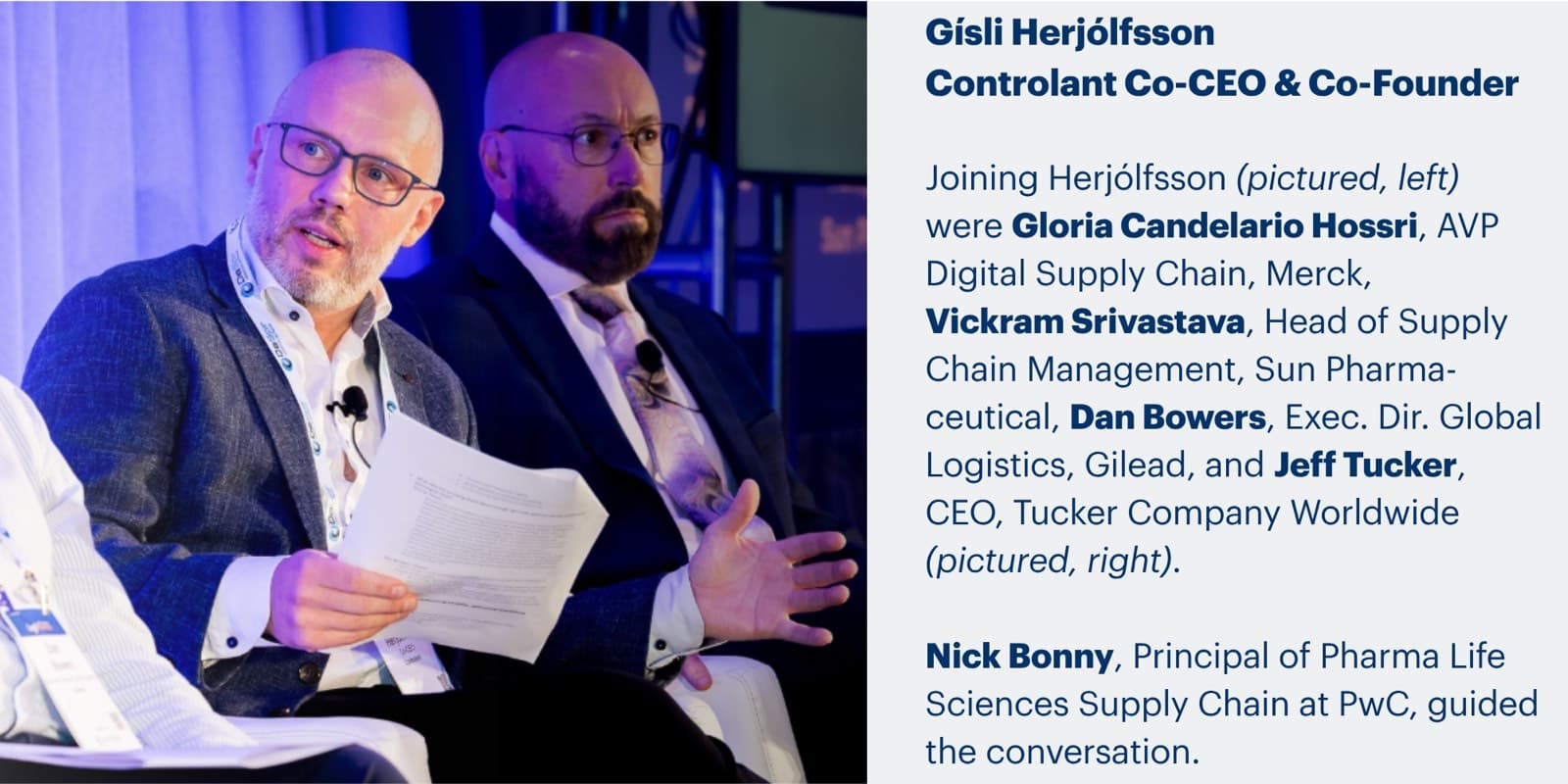
Building resilient pharma supply chains: lessons from industry leaders
Insights from the opening keynote panel for the 20th Anniversary Event of LogiPharma US, 29 September 2025
Read
How to avoid 16,700t CO2e: a case study with Controlant and Vodafone
A groundbreaking case study conducted by the Carbon Trust, in collaboration with Controlant and Vodafone, highlights the transformative potential of real-time monitoring in pharmaceutical supply chains.
Read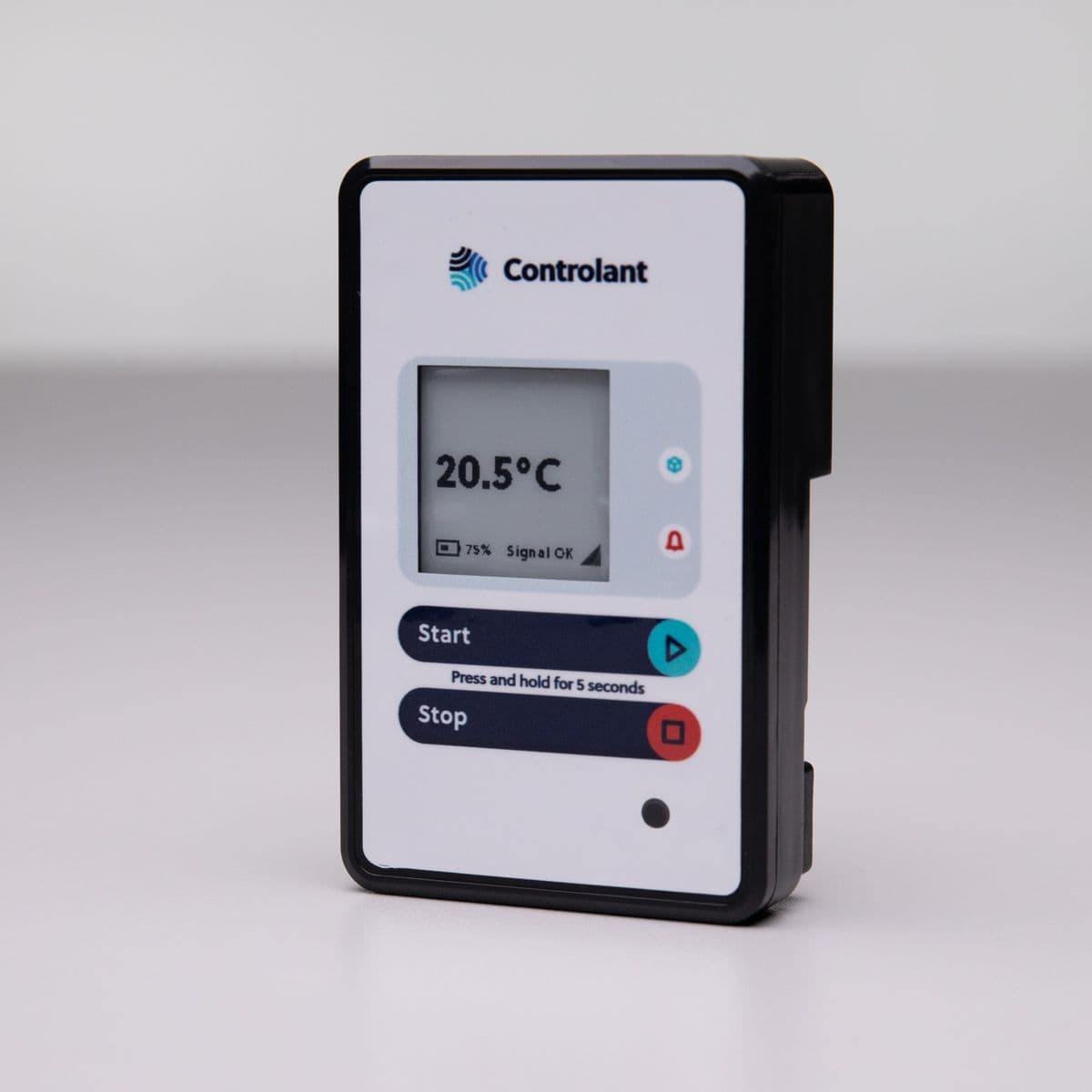
Why real-time temperature monitoring, and when it isn't worth it
A device read on arrival and one that reports in transit record the same excursion. Real-time changes when someone finds out, and so what they can still do: cut it short, release on arrival, fix the lane. Where that pays, and where a device read on arrival is the better choice.
ReadSee what this looks like in the platform
Tell us what you ship and where, and we'll show you the platform on routes and products like yours.